High return mutual funds in India are equity-heavy schemes that put your money into the stock market instead of letting it sit in a savings account. Over the years, they’ve grown wealth faster than FDs, though that growth comes with real ups and downs.
Raj, a 28-year-old software engineer from Pune, kept his savings locked in an FD for three years. Then his friend showed him what a mutual fund portfolio had earned in that same window, and the gap honestly stunned him.
This isn’t an unusual story. Across India right now, a lot of people are quietly moving money out of FDs because high return mutual funds, given enough time, just perform better.
How Do High Return Mutual Funds Work?
A fund manager pools money from thousands of investors and buys stocks, bonds, or some mix of both on their behalf. The goal is usually to beat the broader market over time.
Money in a savings account doesn’t really do anything. Money in a mutual fund does – it’s moving, rebalancing, reacting to whatever’s happening in the market that week.
When the companies in the fund’s portfolio perform well, the fund’s NAV goes up, and so does your investment.
Which Types of High Return Mutual Funds Exist in India?
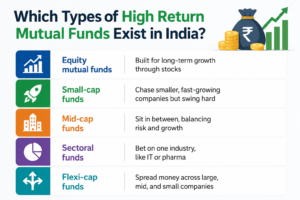
Not every fund under this label works the same way, and the risk gap between them can be pretty wide. Here’s a rough breakdown of what’s out there:
- Equity mutual funds – built for long-term growth through stocks
- Small-cap funds – chase smaller, fast-growing companies but swing hard
- Mid-cap funds – sit in between, balancing risk and growth
- Sectoral funds – bet on one industry, like IT or pharma
- Flexi-cap funds – spread money across large, mid, and small companies
Picking one usually comes down to how much volatility you can actually stomach, not what’s trending on social media.
Why Do High Return Mutual Funds Carry More Risk?
Equity markets move on news, sentiment, and sometimes nothing at all – that unpredictability is exactly where the risk comes from. A single earnings report or global event can swing prices overnight.
So returns from high return mutual funds are never locked in. A fund that gave 18% last year could easily fall short this year, or even dip into the red.
That’s also why people who can stay invested for five, ten, or more years tend to do better here. They’re not panic-selling every time the market wobbles.
What Returns Can High Return Mutual Funds Actually Offer?
Looking at historical data, high return mutual funds in India have averaged somewhere between 12% and 18% a year over long stretches. None of that is promised going forward, though.
| Fund Type | Typical Return Range | Risk Level |
| Large-cap funds | 10% to 14% | Moderate |
| Mid-cap funds | 13% to 17% | High |
| Small-cap funds | 14% to 20% | Very High |
| Flexi-cap funds | 12% to 16% | Moderate to High |
These numbers come from past cycles, and markets don’t always repeat themselves.
How Should Investors Choose High Return Mutual Funds?
It mostly comes down to matching the fund’s risk with your own timeline and comfort level. A 25-year-old saving for retirement can take on more risk than someone who needs the money in three years.
A few things worth checking before putting money in:
- How long can you actually leave the money untouched
- Whether you can handle watching the value drop without panicking
- The fund manager’s track record across both good and bad years
- The expense ratio – high fees quietly chip away at returns
- Spreading investments across a few fund types instead of just one
Revisiting these once a year keeps things on track as goals change.
Are High Return Mutual Funds Suitable for Beginners?
Beginners can start small and still do fine, as long as the fund matches their risk comfort. A Systematic Investment Plan, or SIP, makes this a lot less stressful than dumping in a lump sum.
With a SIP, fixed amounts go in every month instead of all at once. Over time, this evens out the highs and lows without anyone needing to time the market perfectly.
In cities like Mumbai, Bangalore, and Delhi, more first-time investors are leaning toward SIPs over picking individual stocks – it just feels more manageable.
What Should Investors Check Before Investing in High Return Mutual Funds?
Past performance matters, but only when you look at it across full market cycles, not just one strong year. A fund that does great in a bull run might fall apart when the market turns.
It also helps to actually read where the fund is investing and why. Pages like High return mutual fund explain how mutual fund returns get calculated, which clears up a lot of confusion for newer investors.
This article is for general understanding only, not financial advice. Talking to a registered financial advisor before investing still makes sense, since everyone’s situation looks a little different.
Frequently Asked Questions
What is considered a good return for mutual funds in India?
Somewhere between 12% and 15% a year is generally seen as solid for equity mutual funds long-term.
Are high return mutual funds safe for short-term goals?
Not really – short-term swings can hurt returns, so these work better for longer goals.
How much should a beginner invest in mutual funds monthly?
Starting with 500 rupees a month through a SIP works fine, and you can increase it later.
Do high return mutual funds guarantee profits?
No, returns depend on market performance and are never guaranteed, regardless of past numbers.
Which mutual fund category gives the highest returns historically?
Small-cap funds have shown the strongest historical returns, though they also carry the most risk.
Follow us on Instagram, LinkedIn, Facebook and X (Twitter) for the latest mutual fund insights, SIP tips, investment strategies, and personal finance updates.