Look, if you’re planning to start a business, you’re probably thinking about how you’re going to fund the whole thing. Most people don’t have 20-30 lakhs sitting in their bank account. So you look at loans. But here’s where things get confusing for a lot of entrepreneurs – they think a startup business loan works the same way as a regular business loan. It doesn’t.
I’m going to walk you through why a startup business loan is treated completely differently by lenders. The gap between the two is actually pretty massive when you really understand what’s happening behind the scenes.
Your uncle who runs a successful shop for ten years? He can get a regular business loan pretty easily because the bank can look at years of proof that his business works. You, with your brand new idea and zero revenue? You’re getting a startup loan, and the rules are basically different for everything.
What Actually Makes a Startup Business Loan So Different From a Regular Business Loan?
The reason lenders handle a startup business loan differently comes down to one thing – they have no idea if you’re going to succeed. That’s the honest truth. With a regular business loan, the bank is basically looking at a business that’s already proven it can make money. The risk is lower because the track record exists.
With a startup business loan, you’re asking someone to take a real gamble on you. Your business might be brilliant, but it might also collapse in six months. Nobody knows yet. So lenders have to be way more careful. They can’t just look at profit numbers because there are no profit numbers to look at.
Key differences between the two:
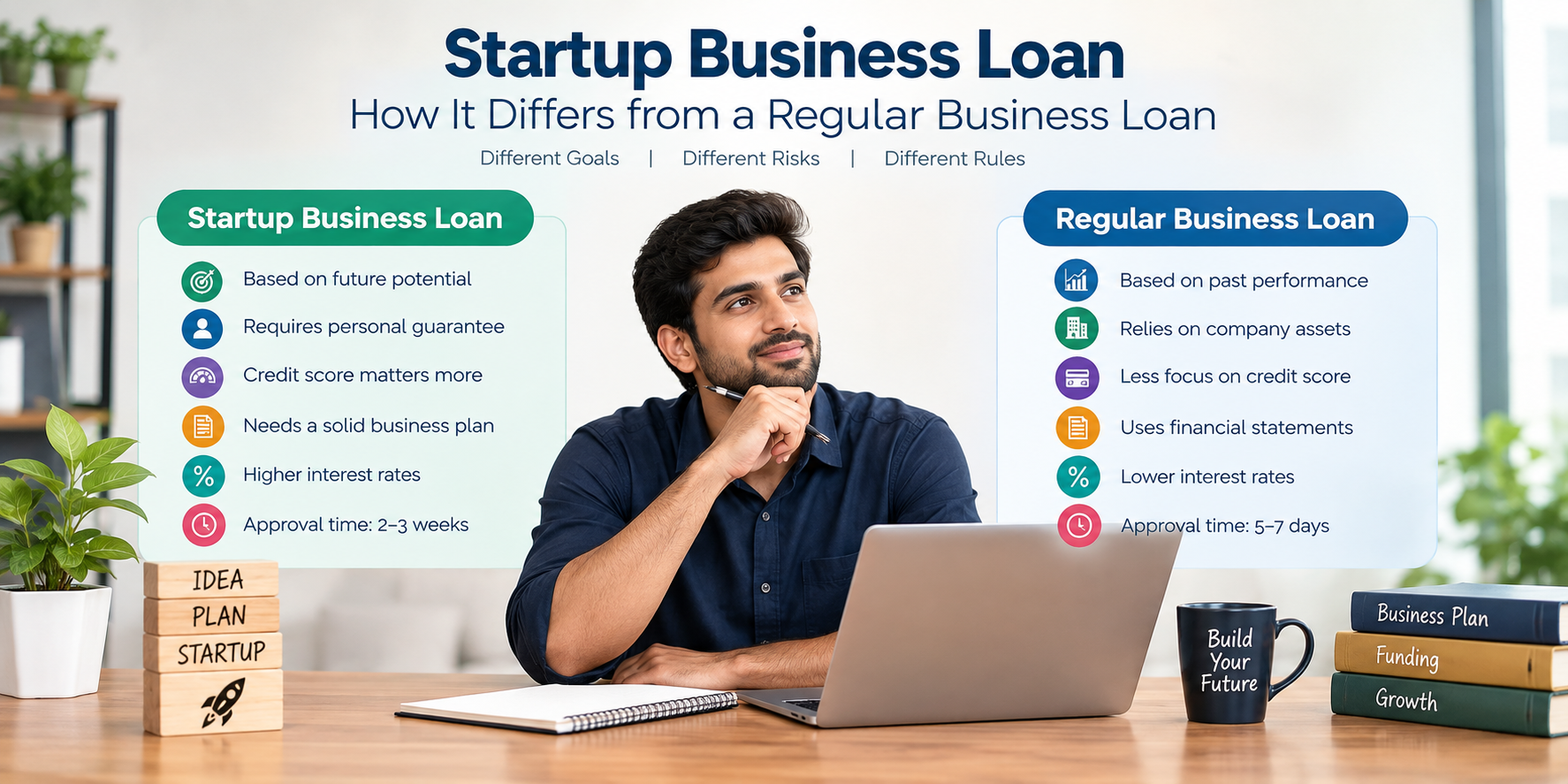
- Startup business loan is based on future potential; regular business loan is based on past performance
- A startup business loan requires a personal guarantee; a regular business loan relies on company assets
- Your credit history matters way more for a startup business loan
- Startup business loan approval depends on business plan evaluation
- Regular business loan approval is data-driven from financial statements
With a regular business loan, it’s way more straightforward. Show me three years of tax returns. Show me your bank statements. Do the math. Done. But a startup business loan requires the lender to think like they’re evaluating a new investment. It’s a completely different mindset.
What Do You Actually Have to Submit for a Startup Business Loan?
When you walk into a bank asking for a startup business loan, forget about business income tax returns. You don’t have any. You can’t show something that doesn’t exist yet. So what do they actually want from you?
First, they’re going to pull your personal credit report. That becomes your financial history. This is where your personal money management matters. Have you been paying your bills on time? Are you drowning in credit card debt? Have you ever defaulted on a loan? All of this tells the lender something about how seriously you’ll treat their money. If you’ve been careless with your own finances, they’re thinking you might be careless with theirs too. This is why your credit score is so important for a startup business loan.
Next, you need a business plan. And I mean a real one, not something you wrote up at 2 AM after a few drinks. This needs to be something that shows you’ve actually done your homework. You explain what problem your business solves, who’s going to pay for it, why your idea is better than what’s already out there, and how you’re going to make money. When you’re trying to get a startup business loan, this document is basically your pitch. It’s how you convince them you’re not just chasing a fantasy.
Here’s what you’ll need to gather for your startup business loan application:
- Your personal credit report and your credit score (get it yourself first to see what they’ll see)
- A business plan that actually shows you’ve researched your market
- Proof that you’ve put your own money into this – bank statements showing you saved something
- Any certificates, degrees, or licenses that show you know your industry
- Your personal financial statement listing what you own and what you owe
- Names of people who can vouch for your work ethic and reliability
- A list of everything you own that you’re willing to pledge as collateral
- Your ID proof and address proof documents
You also need to show you actually believe in this thing enough to risk your own money. If you’re asking to borrow 5 lakhs for a startup business loan but you haven’t invested anything yourself, the banker sitting across from you is going to wonder why. Why should they risk their bank’s money if you won’t risk your own? So pull together proof that you’ve saved something, that you’ve actually put your own cash into this venture. Show them you’re willing to go down with the ship if it sinks. That skin in the game matters way more than people realize.
Why Does a Startup Business Loan Cost So Much More?
This is the part that stings your wallet. Your interest rate on a startup business loan is going to be higher. Maybe significantly higher. A company with five years of stable profits might get a regular business loan at 6 or 7 percent. You’re probably looking at 10, 12, or even 15 percent for a startup business loan.
Why? Because startups have a much higher failure rate. Lenders know the statistics. Way more new businesses fail than succeed. So they charge higher interest rates to cover that risk. From their perspective, they need that extra interest to make up for all the startup loans that go bad.
Think about the actual money impact. On a startup business loan of 10 lakhs at 12 percent over five years, you’re paying roughly 2.6 lakhs just in interest. If that same loan was a regular business loan at 7 percent, you’d pay around 1.8 lakhs in interest. That’s almost 80,000 rupees more you’re paying because you’re a startup. That’s real money coming out of your business profits every single month.
Interest rate factors for your startup loan:
- Your credit score (650+ is minimum, 750+ gets better rates)
- How much collateral you’re putting up
- Your experience in the industry
- How solid your business plan looks
- What the RBI rates are doing
- How brave the lender is feeling
Your credit score moves this needle a lot too. If your credit is excellent, you might get a startup business loan at 9 or 10 percent. If your credit is just okay, you could be paying 14 or 15 percent. That difference adds up fast over the life of the loan.
How Much Longer Does a Startup Business Loan Take to Get Approved?
When you apply for a regular business loan, the bank can move fast. They pull the financials, run the numbers, and make a decision. Five to seven days, and you usually have your answer.
A startup business loan? Plan on waiting two to three weeks minimum. Sometimes longer. The lender needs time to actually evaluate whether your business idea makes sense. They’re reading your business plan carefully, thinking about whether the market opportunity is real, trying to figure out if you understand what you’re getting into.
Timeline breakdown for your startup business loan:
- Document collection and verification: 3-5 days
- Business plan evaluation: 5-7 days
- Credit check and background verification: 2-3 days
- Final decision and approval: 2-3 days
- Total startup business loan approval time: 15-20 days
This longer timeline actually works in your favor, though. It means they’re taking your startup loan seriously. They’re not just rubber-stamping it. They’re doing real due diligence.
What About Putting Up Collateral for a Startup Business Loan?
Most lenders won’t give you a startup business loan without something backing it up. Your new business doesn’t have assets yet, so they need your personal assets as security. Your car, property, savings, equipment you plan to use – all of this can secure a startup loan.
Typically, the collateral needs to be worth 75 to 100 percent of what you’re borrowing. It’s insurance for the lender. If your startup fails, they can take your collateral to recover their money.
Common collateral for startup business loans in India:
- Residential or commercial property
- Vehicle with clear ownership
- Jewellery or gold
- Fixed deposits or savings accounts
- Post office savings schemes
- Insurance policies with surrender value
- Personal guarantee from a co-signer
|
Aspect |
Startup Business Loan | Regular Business Loan |
|
Approval Time |
2-3 weeks | 5-7 days |
|
Interest Rate |
10-15% | 6-9% |
|
Credit Score Needed |
650+ | 620+ |
| Documentation | Business plan, personal credit |
Tax returns, financial statements |
| Collateral Required | Usually required |
Sometimes required |
| Loan Amount Range | 50,000 to 50 lakhs |
1 lakh to 5 crore+ |
| Repayment Period | 3-7 years |
7-10 years |
For detailed information about business loans in India, visit R9 Wealth Business Loan Solutions.
Questions About Startup Business Loans
1. How much can you borrow with a startup business loan?
Most banks offer startup business loans between 50,000 and 50 lakhs depending on your collateral and credit score.
2. What credit score do you need for a startup business loan?
Most lenders want a minimum credit score of 650 for startup business loan approval to move forward.
3. Can you get a startup business loan without collateral?
Some online lenders offer unsecured startup business loans but charge significantly higher interest rates.
4. How long do you have to repay a startup business loan?
Usually three to seven years for a startup business loan, depending on the amount borrowed.
5. Are there government programs for startup business loans?
Yes, schemes like PMMY and state government guarantees help reduce startup business loan interest rates.
Follow us on Instagram, LinkedIn , Facebook, and X (Twitter) for expert mutual fund insights, investment tips, and the latest financial updates.