- Mon - Sat: 9:00 AM - 6:00 PM
- +91 99712 95533
- info@r9wealth.com
Medical emergencies don’t wait for a convenient time, and they rarely affect just one person in a house. A parent’s sudden hospital admission, a child’s accident, a grandparent needing surgery – these things ripple through an entire household, both financially and emotionally. That’s the problem full family health insurance is meant to solve, bringing multiple family members under one shared policy and making healthcare expenses easier to manage. Rather than buying a separate policy for every member, one family plan brings the policyholder, spouse, children, and often dependent parents under a single cover.
At R9 Wealth, we spend our time helping households compare plans across leading insurers in India, so the final decision isn’t based on guesswork – or whichever plan an agent happened to be pushing that week. Finding the right cover for your family means looking past the brochures and actually weighing coverage, premium, and claim history together. The goal is to match the plan to the family, not the other way around.
Buying individual policies for each person usually costs more and leaves you tracking more paperwork. Family medical insurance plans can solve both problems through a single floater policy, while also giving the household access to a range of benefits:
None of this makes family health insurance a luxury. It’s closer to a basic safety net – one that fewer and fewer Indian households can really afford to go without.
Family medical insurance isn’t built for one particular type of household. It tends to make the most sense for families who want shared coverage, simpler policy management, and financial protection against unexpected medical expenses:
Whether it’s a nuclear family of three or a joint household with grandparents living in, there’s usually a plan structured to fit. What works best really comes down to household size, existing health conditions, and budget – there’s no single formula that suits everyone.
Strengthen your family’s financial security with the right Term Insurance plan.
Most Family Health Insurance plans, regardless of insurer, cover a fairly similar core set of benefits. This is roughly the checklist worth running through before you decide:
In-Patient Hospitalisation – room rent, doctor’s fees, nursing charges, and treatment costs for stays beyond 24 hours.
Pre- and Post-Hospitalisation Expenses – the consultations, tests, and medicines that come before admission and continue after discharge.
Day Care Procedures – cataract surgery, chemotherapy, dialysis, and other treatments that don’t require a full day in the hospital.
Emergency Ambulance Services – costs during a medical emergency, up to the policy’s limit.
Family Floater Coverage – a single sum insured that any covered member can draw from, rather than fixed individual limits.
Pre-Existing Disease Coverage – kicks in once the insurer’s waiting period has passed.
Maternity and Newborn Benefits – pregnancy, delivery, and early newborn care, usually after a waiting period.
Preventive Health Check-Ups – annual screenings meant to catch problems early.
AYUSH Treatment Coverage – Ayurveda, Yoga, Unani, Siddha, and Homeopathy, as per policy terms.
Mental Health Coverage – hospitalisation and treatment for mental health conditions, in line with regulatory requirements.
Cashless Hospitalisation – direct billing at network hospitals, so nobody’s paying out of pocket mid-crisis.
Coverage limits, waiting periods, and fine print differ from insurer to insurer – which is really the whole argument for comparing plans properly instead of settling for the first quote that lands in your inbox.
Planning to buy your family’s dream home? Compare our Home Loan options.
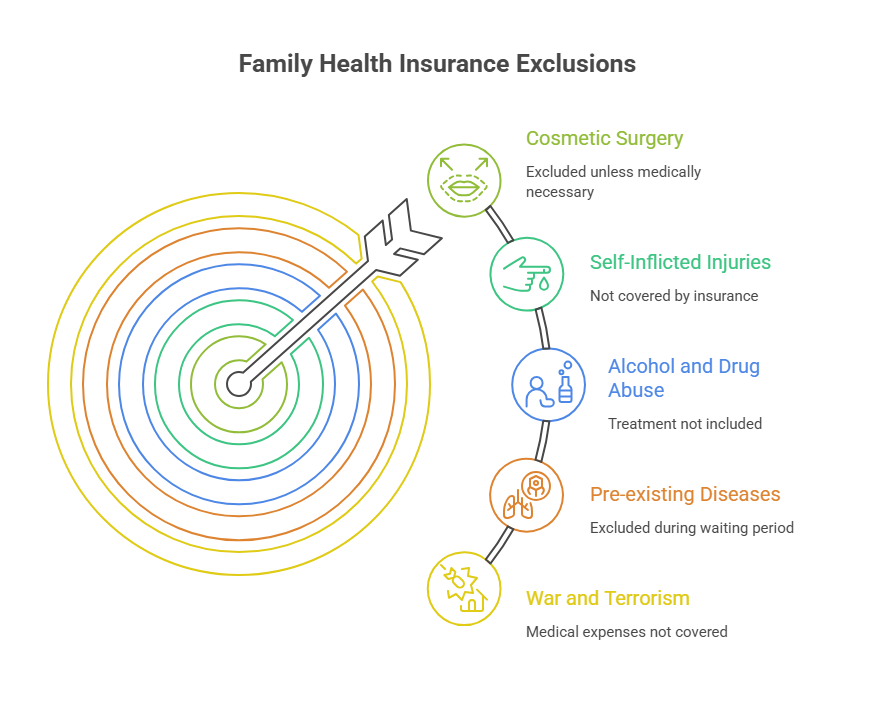
It helps to know what’s excluded, too. Common exclusions across most policies include:
Claims can also run into trouble over waiting periods, sub-limits, co-payment clauses, or incomplete disclosure at the time of purchase. Reading the policy wording properly before signing tends to save a lot of grief later, at claim time.
Most insurers work within a broadly similar framework:
Criteria | Specification |
Primary Policyholder Age | 18 years and above |
Child Entry Age | 90 days onwards, typically up to 25 years |
Eligible Members | Spouse, children, parents, and in some plans, parents-in-law |
Residency | Available to Indian residents; some insurers also cover NRIs |
Beyond age and family composition, insurers also look at existing medical conditions, habits like smoking, the sum insured chosen, and their own underwriting rules. Being upfront and accurate at the application stage protects the family later – incomplete or incorrect information can affect both approval and how smoothly a claim gets settled down the line. Meet these basic conditions, disclose things honestly, and qualification is usually straightforward.
Secure your family’s future by combining insurance with long-term investments in Mutual Funds.
Picking the right plan isn’t just about chasing the highest sum insured or the lowest premium – it’s about weighing the two against what your household actually needs. That’s where we come in. In practice, here’s what working with us looks like:
We compare plans across leading insurers first, so you’re looking at several genuine options side by side rather than one. From there, advice gets tailored to your household size and health profile, and the coverage recommendations are built around your family rather than lifted from a brochure. We handle the documentation too, so delays and resubmissions don’t pile up – and if a claim ever needs filing, we stay involved so you’re not left guessing in the middle of an emergency. You also get one point of contact for the entire policy term, instead of someone who disappears the moment the sale closes.
Families searching for the right cover often end up buried under too many options and too much fine print. Our job is to cut through that and land on a plan that actually fits – without the back-and-forth that usually comes with comparing policies on your own.
Medical emergencies don’t send a warning. But a well-chosen family health plan makes sure they don’t also turn into a financial crisis. Comparing plans through R9 Wealth is the simplest way to find affordable family health insurance that fits your household under one roof, without compromising on the coverage your family actually needs.
Connect with R9 Wealth today to compare family health insurance options and choose coverage built around your household’s real needs.
If you’re looking for individual medical coverage, explore our comprehensive Health Insurance plans.
It’s a single policy that covers medical expenses for the policyholder, spouse, children, and sometimes dependent parents, drawing from one combined sum insured.
Generally, yes. A family floater usually works out cheaper than buying separate individual policies for each member.
It depends on the insurer. Some plans allow parents-in-law to be included; others limit coverage to spouse, children, and parents only.
Whatever’s left stays available to the rest of the family until the policy year ends or the sum insured runs out – that’s the whole point of it being shared across a floater.
Many plans do, usually after a waiting period. Terms vary by insurer, so it’s worth checking the policy document directly.
This content is for informational purposes only. Coverage, terms, and exclusions vary by insurer and policy - refer to the official policy document for complete details.
Connect with R9 Wealth on Instagram, LinkedIn, Facebook and X (Twitter) for expert financial insights, market trends, investment tips, and the latest updates.
At R9 Wealth, we provide personalised solutions for loans, insurance, mutual funds, and wealth management to help you achieve your financial goals.
01-041, First Floor MGF Metropolis Mall MG Road, Sector 28 Gurugram – 122002 India
Monday to Saturday: 9:00 AM - 6:00 PM Sunday: Closed
+91 99712 95533
info@r9wealth.com

Office Space Unit No. 01-041, MGF Metropolis Mall, Mehrauli Gurugram Road, Sector 28, Gurugram, Haryana - 122002
Contact No: +91 9971295533
Email: info@r9wealth.com
Mutual Fund investments are subject to market risks, read all scheme-related documents carefully. Past performance is not an indicator of future returns. R9 Wealth is an AMFI registered Mutual Fund distributor with ARN – 334421 (ARN Validity Period: 18-July-2025 to 17-July-2028). R9 Wealth and its brand assets are trademarks of R9 Wealth Financial Services.
© 2026 R9 WEALTH INDIA PRIVATE LIMITED All Rights Reserved.