- Mon - Sat: 9:00 AM - 6:00 PM
- +91 99712 95533
- info@r9wealth.com
Nobody plans a hospital visit. A fever that won’t break, an accident on the way to work, a diagnosis that changes everything overnight – these things arrive without warning. What follows is a bill, and in India, that bill can wipe out years of savings within days. That’s the reason medical health insurance stopped being a nice-to-have and became something closer to a necessity for most households.
R9 Wealth focuses on one job: helping people compare and choose a health insurance plan without the usual runaround. There’s no pushy sales pitch involved, no single plan pushed regardless of fit – just an honest comparison of what’s actually on the market, laid out so the final call stays with the person buying it.
The Indian health insurance market has matured considerably, and today’s policyholders have real choice. Some of the widely preferred health insurance plans in India include:
Each of these differs in sum insured options, room rent limits, co-payment clauses, and add-on riders. A plan that works well for a 28-year-old professional in Bengaluru may fall short for a joint family in Jaipur with ageing parents at home. That gap is where R9 Wealth steps in – matching plans to people, instead of pushing whatever’s easiest to sell.
Looking to cover your entire family? Compare our Family Health Insurance plans.
Healthcare costs in India have climbed faster than general inflation for years now, and nothing suggests that’s about to slow down. A hospitalisation that cost a certain amount five years back costs noticeably more today. A solid health care insurance policy can push back against those rising costs in a few concrete ways:
This isn’t a checklist for the health-conscious alone. It applies just as much to someone who’s never spent a night in a hospital, because insurance isn’t bought for the version of life where nothing goes wrong.
Honestly, almost everyone qualifies as someone who should have coverage. But a few groups need it more than others:
Waiting for a health scare before buying cover tends to be one of the costliest financial mistakes a person can make. Premiums climb with age, and once a pre-existing condition enters the picture, coverage gets complicated or delayed altogether.
Pair your health coverage with Term Insurance for complete financial protection.
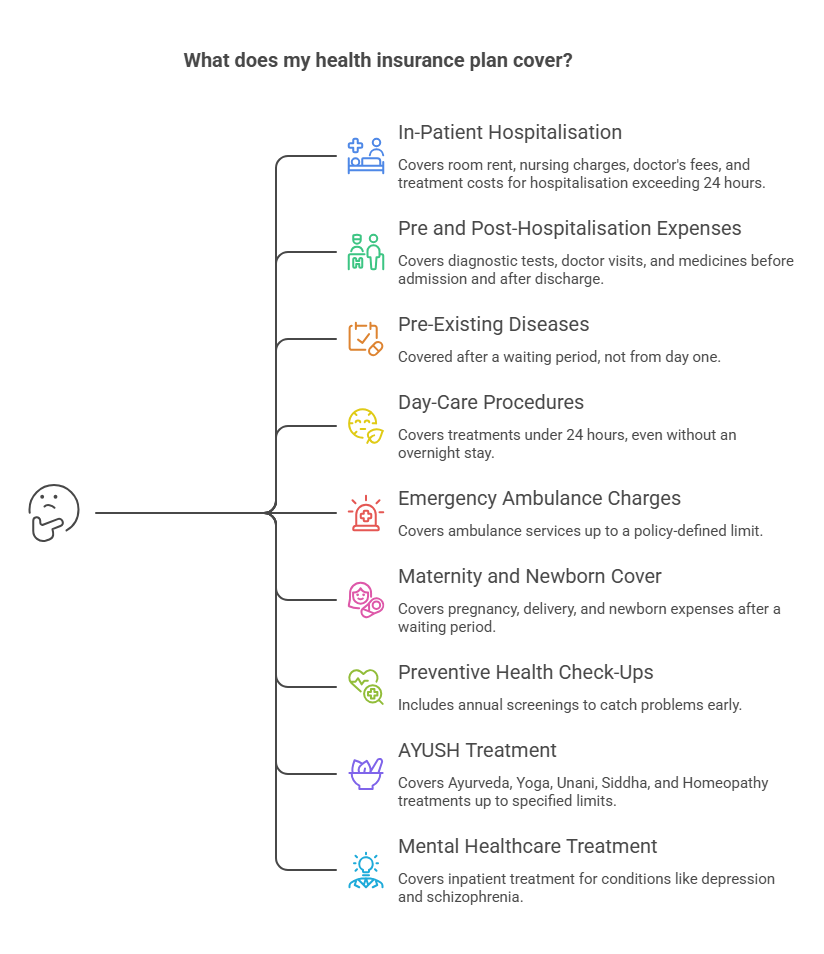
Across insurers, most health and medical insurance plans in India extend coverage to roughly the same core areas:
In-Patient Hospitalisation – Room rent, nursing charges, doctor’s fees, and treatment costs for hospitalisation exceeding 24 hours.
Pre and Post-Hospitalisation Expenses – the diagnostic tests, doctor visits, and medicines that come before admission and continue after discharge are covered too.
Pre-Existing Diseases – not covered from day one. Insurers apply a waiting period first, and only after that runs out does a pre-existing condition qualify.
Day-Care Procedures – cataract surgery, chemotherapy, dialysis, and similar treatments that wrap up in under 24 hours still count, even without an overnight stay.
Emergency Ambulance Charges – there’s a limit here, set by the policy, so it’s worth checking what that cap actually is.
Maternity and Newborn Cover – pregnancy, delivery, and the newborn’s early expenses, usually kicking in only after a waiting period has passed.
Preventive Health Check-Ups – most plans throw in an annual screening, mainly so problems get caught before they turn serious.
AYUSH Treatment – Ayurveda, Yoga, Unani, Siddha, and Homeopathy treatments, up to specified limits.
Mental Healthcare Treatment – In line with the Mental Healthcare Act, 2017, insurers are required to cover inpatient treatment for conditions like depression and schizophrenia.
Coverage specifics change based on the insurer, the sum insured, and the type of policy picked, which is precisely why comparing plans side by side beats going with the first recommendation that comes along.
In case of urgent financial needs, you can also explore our Personal Loan solutions.
Coverage has limits too, and it helps to know them upfront. Before choosing a health insurance policy, it’s important to understand the exclusions and conditions that may apply:
None of this is meant to discourage buying cover – it’s meant to set expectations right. A claim gets rejected far more often over a missed exclusion than over anything dramatic, so going through the policy wording line by line before signing is worth the ten minutes it takes.
Before you buy health insurance, it’s important to check the insurer’s eligibility criteria, age requirements, and pre-medical screening conditions. Most insurers work within a fairly similar framework, though the fine print differs from one to the next:
Criteria | Specification |
Entry Age (Adults) | 18 years onwards |
Entry Age (Dependent Children) | 90 days to 25 years |
Pre-Medical Screening | Usually required at least 45/55/60 years, depending on the plan |
Beyond age, insurers also look at pre-existing conditions, lifestyle habits such as smoking or drinking, occupation-linked risk, and BMI. Full and honest disclosure at the time of purchase matters more than most people realise. It’s one of the biggest reasons genuine claims end up getting rejected down the line.
Identity Proof – Aadhaar, PAN, Passport, Voter ID, or Driving License
Address Proof – Aadhaar, Passport, Voter ID, Driving License, or utility bills
Age Proof – Birth certificate, Aadhaar, PAN, or Passport
Income Proof – Salary slips, bank statements, Form 16, or ITR, where applicable
Medical Records – Existing policy details or past medical history, if any
Photographs and Proposal Form – As required by the insurer
Going with a single insurer means seeing just one set of numbers. R9 Wealth changes that by putting several medical health insurance policy on the table before recommending anything:
The goal here isn’t to sell a policy. It’s making sure the one chosen actually holds up the day it’s needed.
Planning to purchase a home? Check out our affordable Home Loan options.
Advertisements don’t decide which health insurance plan suits someone best – age, family situation, health history, and budget do. That’s the fit R9 Wealth works toward, cutting through the noise so the choice becomes clear rather than confusing.
Comparing health insurance plans through R9 Wealth is the quickest way to land on coverage that actually holds up when it’s needed.
Earlier is better. Premiums stay lowest in the twenties and early thirties, and pre-existing conditions are less likely to complicate coverage at that stage.
No. Pre-existing diseases are usually covered only after a waiting period, typically ranging from one to three years, depending on the insurer and plan.
Cashless treatment applies only at hospitals within the insurer’s network. Treatment at a non-network hospital usually requires reimbursement instead.
Yes. A family floater plan allows a single sum insured to be shared across the policyholder, spouse, children, and sometimes dependent parents, under one premium.
An appeal can be filed with the insurer along with supporting documents. If the matter stays unresolved, it can be escalated to the insurance ombudsman or IRDAI’s grievance cell.
This content is for informational purposes only. Coverage, terms, and exclusions vary by insurer and policy - refer to the official policy document for complete details.
Connect with R9 Wealth on Instagram, LinkedIn, Facebook and X (Twitter) for expert financial insights, market trends, investment tips, and the latest updates.
At R9 Wealth, we provide personalised solutions for loans, insurance, mutual funds, and wealth management to help you achieve your financial goals.
01-041, First Floor MGF Metropolis Mall MG Road, Sector 28 Gurugram – 122002 India
Monday to Saturday: 9:00 AM - 6:00 PM Sunday: Closed
+91 99712 95533
info@r9wealth.com

Office Space Unit No. 01-041, MGF Metropolis Mall, Mehrauli Gurugram Road, Sector 28, Gurugram, Haryana - 122002
Contact No: +91 9971295533
Email: info@r9wealth.com
Mutual Fund investments are subject to market risks, read all scheme-related documents carefully. Past performance is not an indicator of future returns. R9 Wealth is an AMFI registered Mutual Fund distributor with ARN – 334421 (ARN Validity Period: 18-July-2025 to 17-July-2028). R9 Wealth and its brand assets are trademarks of R9 Wealth Financial Services.
© 2026 R9 WEALTH INDIA PRIVATE LIMITED All Rights Reserved.