Priya lost her job in March, right in the middle of treatment for a fractured wrist. Her employer health insurance stopped covering her hospital bills the same week her resignation took effect. The personal health insurance policy she had bought two years earlier picked up the rest of the cost without a break. That single week is the clearest way to understand employer health insurance vs personal health insurance, and why the choice matters long before a crisis forces it.
This article breaks down employer health insurance vs personal health insurance across ownership, coverage, cost, and continuity, so you can decide what your family actually needs.
What Is The Core Difference Between Employer Health Insurance And Personal Health Insurance?
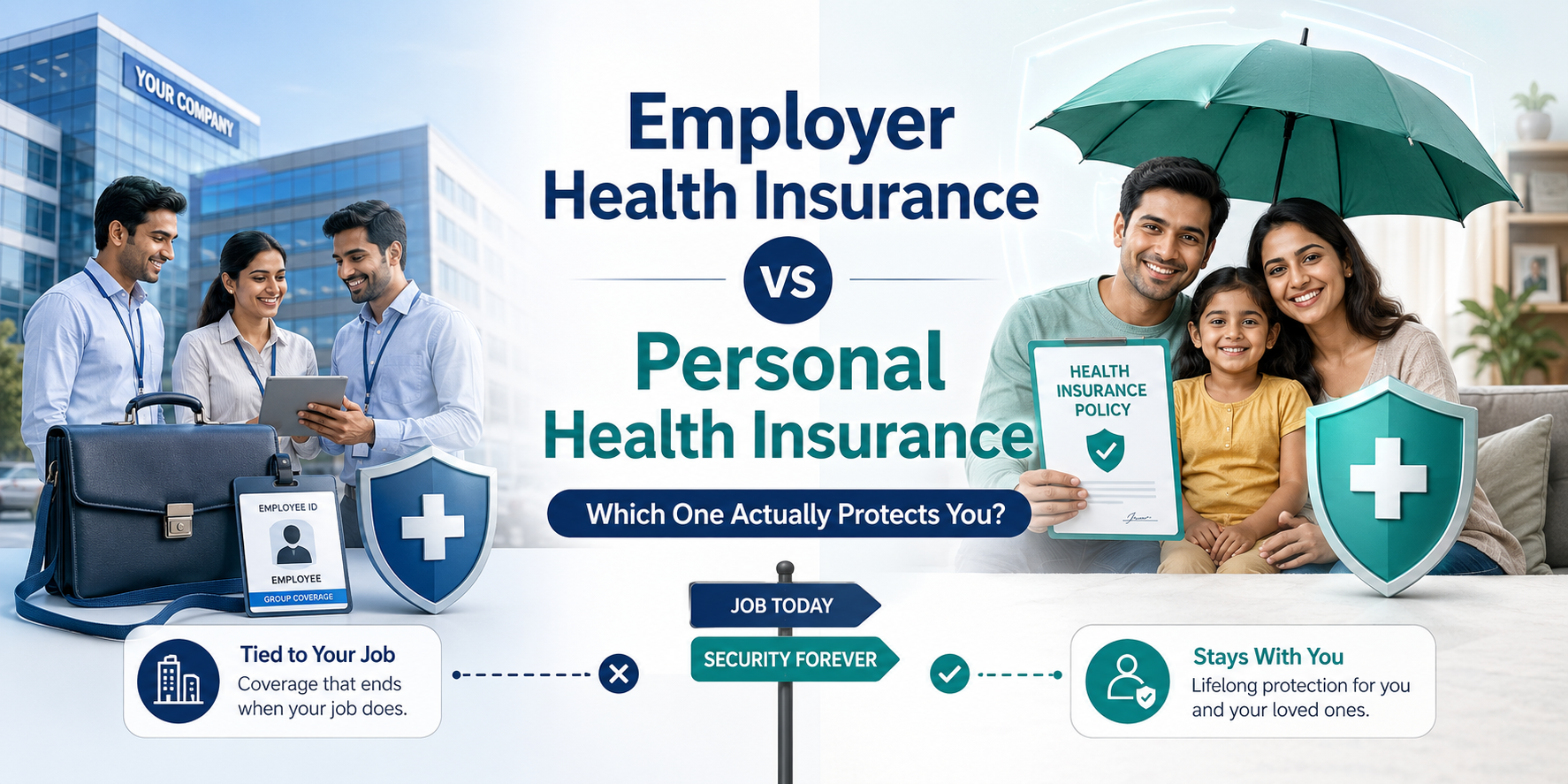
Ownership is the core difference between employer health insurance and personal health insurance. Employer health insurance belongs to the company and ends the day you leave. Personal health insurance belongs to you and stays active for as long as you pay the premium.
A few points make employer health insurance vs personal health insurance easy to separate:
- Employer health insurance is a group policy with the same terms for every employee
- Personal health insurance can be shaped around your own medical history and budget
- Employer health insurance premiums are mostly paid by the company
- Personal health insurance premiums come directly from your own pocket
Once this distinction is clear, treating employer health insurance as a permanent safety net stops making sense.
Which Plan Offers Better Coverage, Employer Or Personal Health Insurance?
Personal health insurance usually wins here. Sum insured limits run higher, and you will not run into the blanket restrictions that come baked into most group plans. Employer health insurance, by contrast, hands every employee the same fixed limit whether they are a 25-year-old with no dependents or a parent of three managing a chronic condition.
The gap shows up most clearly in what each plan leaves out. Room rent caps and treatment exclusions are common under a company policy, and pre-existing conditions rarely get covered from the first day you join. A personal plan works differently. You can add riders for critical illness or maternity, and the base cover itself can be built around your family’s actual medical history rather than a template written for the average employee.
Ask a few practical questions before assuming your group policy has you covered:
- Does it exclude specific treatments, or cap what it pays for room rent?
- Can you add riders like critical illness or maternity cover, or is the policy fixed as-is?
- Are pre-existing conditions covered immediately, or only after a waiting period?
- Does the sum insured reflect your family’s real medical history, or a generic average?
Once you run through these, employer health insurance vs personal health insurance stops being a close call. A personal plan simply leaves more room to shape coverage around the people it is actually protecting.
How Do Premiums Differ Between Employer Health Insurance vs Personal Health Insurance?
Premiums are where employer health insurance vs personal health insurance splits the most. Employer health insurance premiums are free or heavily subsidised. Personal health insurance premiums are paid entirely by the policyholder, year after year.
| Factor | Employer Health Insurance | Personal Health Insurance |
| Premium Cost | Free or subsidised by the company | Paid fully by the policyholder |
| Coverage Continuity | Ends with a job change | Continues for life |
| Customisation | Limited, fixed group terms | High, tailored to individual needs |
| Waiting Period | Often waived for current staff | Standard waiting period applies |
Viewed this way, the trade-off between short-term savings and long-term security becomes easy to see.
Does Employer Health Insurance Continue After You Leave A Job?
No, employer health insurance usually stops the day employment ends, unless the company offers a conversion option, and most do not. This gap is one of the biggest weaknesses that shows up in employer health insurance vs personal health insurance planning.
Situations where this gap becomes a real problem:
- Switching jobs while mid-treatment for an illness or injury
- A gap between two jobs with zero active coverage
- A sudden layoff that leaves the whole family uninsured
- Retirement, which permanently shuts off employer health insurance
Personal health insurance avoids this risk entirely, since it remains active as long as premiums are paid on time, independent of your employment status.
Can A Family Depend Only On Employer Health Insurance?
No, depending only on employer health insurance leaves most families exposed. Group policies often cap coverage per employee and leave out several dependents. This is exactly where employer health insurance vs personal health insurance planning works best when both run side by side.
Reasons families need more than employer health insurance alone:
- Parents are sometimes excluded from the company policy altogether
- Coverage limits can fall short during a major hospitalisation
- A single job loss removes protection for the entire household
- Local hospital charges can exceed what the group policy allows
Financial planners generally treat employer health insurance as a bonus layer, not the primary safety net a household should rely on.
Which Local Factors Should Influence Your Health Insurance Choice?
City-specific hospital costs and network availability should shape your final decision. Treatment costs in metro cities such as Jaipur, Delhi, or Mumbai often run higher than the standard limits set under most employer health insurance plans. Checking whether your preferred hospitals fall under a personal health insurance network before you buy is a practical step many people skip.
Employer Health Insurance Vs Personal Health Insurance: Which Should You Choose?
Neither plan alone is the complete answer. Combining employer health insurance vs personal health insurance gives the most complete protection available. Employer health insurance handles routine costs while you are working, and personal health insurance steps in during job changes, layoffs, or major illness.
Steps worth taking to build the right mix:
- Keep employer health insurance active for as long as you are employed
- Buy personal health insurance early, since premiums rise with age
- Increase personal cover as income and family responsibilities grow
- Review both policies once a year to catch new coverage gaps
An advisor at R9 Wealth can walk you through employer health insurance vs personal health insurance in detail and help you settle on a plan suited to your current life stage.
Learn more about health insurance and understand how the right coverage can protect you and your family from unexpected medical expenses.
FAQ’s on Employer Health Insurance vs Personal Health Insurance
1. Is employer health insurance enough on its own?
No, coverage is often limited and it ends the moment employment stops.
2. Does personal health insurance cost more than employer health insurance?
Yes, personal health insurance premiums are paid entirely by the policyholder.
3. Can I hold employer health insurance and personal health insurance together?
Yes, holding both gives continuous protection along with greater flexibility.
4. What happens to employer health insurance after resignation?
It usually ends immediately unless the company offers a conversion option.
5. Which option offers better long-term security, employer or personal health insurance?
Personal health insurance offers stronger long-term security since coverage never depends on your job.
Follow us on Instagram, LinkedIn , Facebook, and X (Twitter) for expert mutual fund insights, investment tips, and the latest financial updates.